Information Architecture
·Autodesk · 2015–2019
Influencing the Org with IA
Organizational structures shape digital experiences. The inverse is equally true — and equally consequential.

The Challenge
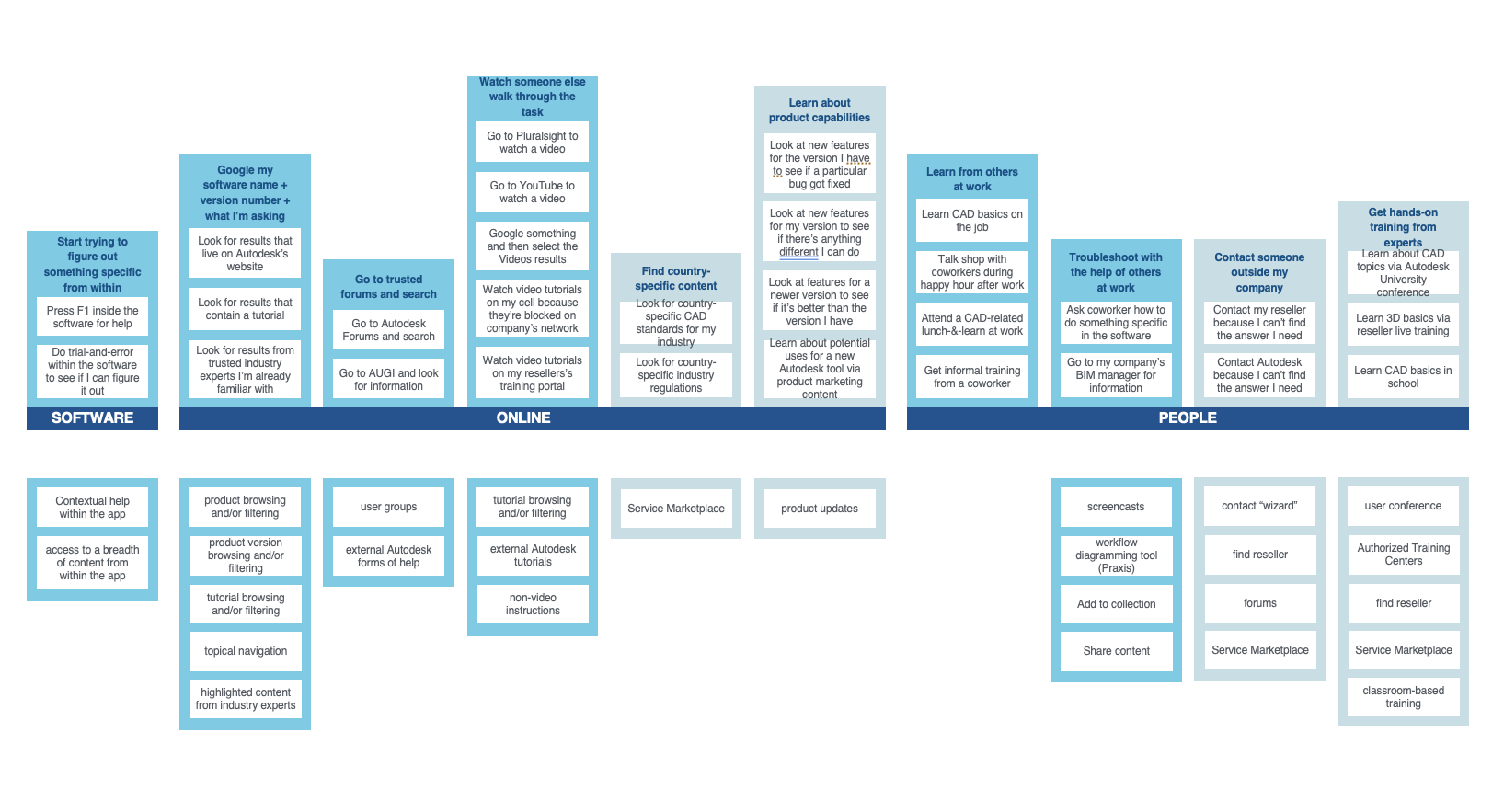
Autodesk grew rapidly throughout the early 2000s, both organically and through acquisition. The product catalog became vast and varied, and each product group built its own help, learning, and support infrastructure — separate teams, separate properties, separate processes.
Progress was made in the early 2010s to consolidate the UX for support, learning, and community. But that effort produced yet another destination, sitting apart from the main .com and from in-product help systems. Customers were still confused about where to find help and how to get it.
Internal stakeholders had their own frustrations. Significant portions of the organization felt excluded from decisions that directly affected their teams — a problem that would need to be solved alongside the customer experience, not after it.
Approach
- 1.
Conduct multi-modal research on user needs and perceptions
This was the first structured look at the subject since the last major IA overhaul. Before making any recommendations, we needed a current, honest picture of how customers actually navigated — and where they got lost.
- 2.
Interview all stakeholders
Not a courtesy — a necessity. One of the sharpest pain points was the lack of collaboration across divisions. When I joined as the first Director of UX for Help, Learn, and Community, I attended a cross-division meeting where a stakeholder — who didn't yet know me — made clear, forcefully, how sidelined they felt. That moment set the tone for how I approached every conversation that followed.
- 3.
Shop the results
Interviews open doors; sharing findings keeps them open. Involving stakeholders and users in the decision-making process — not as owners, but as people whose input genuinely shapes the outcome — builds the trust that large structural changes require. It also surfaces blind spots, including places where your own org's interests might be coloring your recommendations.
- 4.
Sell the concept with self-sacrifice
Once decisions are made, tour them again. Be explicit about what each group is giving up, not just what they're gaining. Acknowledge the friction honestly. In practice, when organizations find real efficiencies, new opportunities open up alongside them — but people won't believe that until they've seen you acknowledge the cost first.
- 5.
Find the path of least resistance
A cross-org IA shift is a multi-year strategic effort, not a sprint. Multiple teams, directors, and VPs need to move in a new direction — and that momentum builds slowly, especially when it's coming from the middle rather than from the C-suite. Identify the near-term wins that create real value for customers and the business. And don't mistake a powerful ally for a persuasive argument. Convincing people you have the right idea travels farther than leveraging a title or an executive relationship.
Outcomes
30% improvement in cross-domain navigation.
Unified three separate UX design teams into a single, cohesive group.
Established the organizational mindset that enabled further consolidation down the road.